
 Prof.
Elhadj BENKHELIFA, Staffordshire university, UK
Prof.
Elhadj BENKHELIFA, Staffordshire university, UK
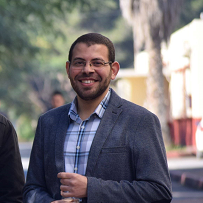
Elhadj Benkhelifa is a Full Professor of Computer Science and the Head of Professoriate at Staffordshire University. He is also the founding Director of the Smart Systems, AI and Cybersecurity Research Centre, managing 20 research staff and 32 PhD Students. He was previously the Director of the Cloud Computing and Applications research centre (2015-2020) and the Director of the Mobile Fusion Applied Research Centre (2014-2016). Elhadj research areas cover cloud computing and applications in its centralised and decentralised forms (Fog/Edge computing, Cloudlet, Blockchain etc), Software Defined Systems. Service Computing, Cybersecurity & Digital Forensics, Data (Governance, Semantics, analytics, Social Networks), Artificial Intelligence and Software Engineering methods . Elhadj has delivered 40+ keynote talks internationally and has edited a number of conference proceedings and special editions of Scientific Journals. He has published 170+ research papers in conferences and journals and has been the Principal Investigator of a number of collaborative projects. Elhadj has chaired many prominent IEEE conferences in different parts of the world. Elhadj is currently the Chair of the IEEE UK&I Section’s Education office and sits on the West Midland Cyber Resilience Centre’s Advisory Board and he sits on the Staffordshire Police Digital Forensics Board. Elhadj is Senior Member of IEEE, a Fellow of the UK Higher Education Academy and Prince2 Practitioner.
Keynote I: How to do cyber Security that works and why it often doesn’t ?
In the ever-evolving landscape of digital threats, the imperative for robust cybersecurity measures cannot be overstated. Despite over four decades of dedicated research and substantial investments to secure our systems and critical infrastructures, the persistent escalation in both the quantity and impact of cyber breaches remains undeniable. Leveraging my experience and research in the field, this presentation delves into the profound disparity between the theoretical underpinnings of effective cybersecurity and the practical obstacles that consistently hinder successful implementation. Drawing on my insights, I aim to persuade the audience of the underlying causes contributing to this "failure." While the conventional approaches of constructing cybersecurity solutions with a focus on fortified defences is undeniably crucial, an exclusive reliance on this approach falls short in today's dynamic threat landscape. Consequently, a pivotal shift towards embracing cybersecurity resilience has become imperative, for forward looking strategies. Cybersecurity resilience, characterised by an organisation's ability to foresee, withstand, recover from, and adapt to cyber threats, emerges as a decisive direction. This presentation advocates for a holistic cybersecurity approach, emphasising the necessity to revisit fundamental principles and consider unconventional solutions, where complex problems do not always demand intricate solutions. I will spotlight some of the ongoing and prospective projects undertaken by my team, showcasing practical applications of the principles discussed throughout the presentation.
 Prof.
Riyadh BAGHDADI, New York University Abu Dhabi
Prof.
Riyadh BAGHDADI, New York University Abu Dhabi
Riyadh BAGHDADI is an assistant professor in computer science at NYU Abu Dhabi (UAE), and a research affiliate at MIT (USA). He works on the intersection of compilers and applied machine learning. He obtained his Ph.D. and master's degrees from Sorbonne University (Paris) and an engineering degree from ESI, Algiers.
Keynote II: Accelerating Deep Learning through Automatic Code Optimization
Accelerating deep learning is extremely important today. It enables the deployment of complex neural networks on embedded devices unlocking the power of deep learning and its applications in many areas, ranging from drones and driverless cars to smartphones and robots. It also enables the training of large neural networks more efficiently. In this presentation we will talk about a method to accelerate neural networks through compiler code optimizations. We propose a novel deep learning cost model that enables automatic code optimization in compilers.
 Prof.
Hamamache KHEDDOUCI, Claude Bernard Lyon 1 University,
France
Prof.
Hamamache KHEDDOUCI, Claude Bernard Lyon 1 University,
France
Hamamache KHEDDOUCI is full Professor in Computer Science at Lyon 1 University since 2004. He received his PhD degree in Computer Science from Paris XI University in 1999. In 2003, he obtained his research supervision habilitation in Computer Science from the Burgundy University, Dijon. in 1992, he obtained an Engineering degree in Computer Science from the National Institute of Computer Science - INI - Algiers. Hamamache KHEDDOUCI was the director of the Computer Science Department of Lyon 1 Technology Institute from 2005 to 2008. From 2008 to 2010, he was Deputy Director of LIESP Laboratory. He was Founder and Director of GAMA Laboratory of Lyon 1 University (2010-2012). At LIRIS CNRS UMR 5205, he was the Founder and Leader of Graphs, Algorithms and Multi-Agents (GrAMA) research group (2012-2014). From 2014 to 2020, he was leader of the research group Graphs, AlgOrithms and AppLications (GOAL-LIRIS). Since 2016, he is co-directing (and directing since 2019) the Doctoral School InfoMaths of Lyon University. His research interest includes combinatorial and algorithmic aspects of graphs and their applications, in particular, in big data, artificial intelligence, cybersecurity and social networks. He has more than ninety publications in international journals (Disc. (Appl.) Math., Pattern Recognition, Information Sciences, KAIS, Social Netw. Analys. Mining,...) and around two hundred publications in international conferences or workshops (ASONAM, CAISE, SCC,…). Hamamache KHEDDOUCI has been PC member of international conferences and workshops including: ICGT, ICSOC, BWG,... He is member of several international research projects (Europe NoE, PHC-Germany, PUF-USA ...) and national (ANR, CNRS, PIA).
Keynote III: Bridges between graph-theoretical models and real graphs
The recent advances in data acquisition and production have led to the generation of very large volumes of (complex) data. Indeed, conventional systems are not able to respond to the issues related to the storage, exploration and analysis of Big Data. Graphs are powerful models that can capture different relationships between data, give them a better representation and facilitate their exploration. However, the graphs obtained from these large datasets are usually too large and heterogenous. Their exploration requires new and effective tools. This brings new research issues. In this talk, we will discuss some real graph data locks and their equivalent issues in graph theory. We will present some theoretical results on graphs that could contribute to solve big data and cybersecurity issues.